Games & Bets
How each game settles, with plain examples.
Presets, or build your own
On the Game Setup screen, the first tile carries your Golfcaster’s name, like Russ’s Picks. Tap it for three one-tap setups. Each one fills in the games and the stakes, with handicaps on:
- Easy. $5 / $5 / $5 Nassau, all three segments match play.
- Standard. $10 / $10 / $20 Nassau plus 25¢ Skins. The classic Saturday game.
- All the Smoke. $20 / $20 / $40 Nassau plus $5 Skins.
Or build your own. Tap every game your group wants (stack as many as you like), then tap Set Stakes. Each game gets a card on your bet sheet with its stakes and one rules line. Tap Change rules on a card to adjust it.
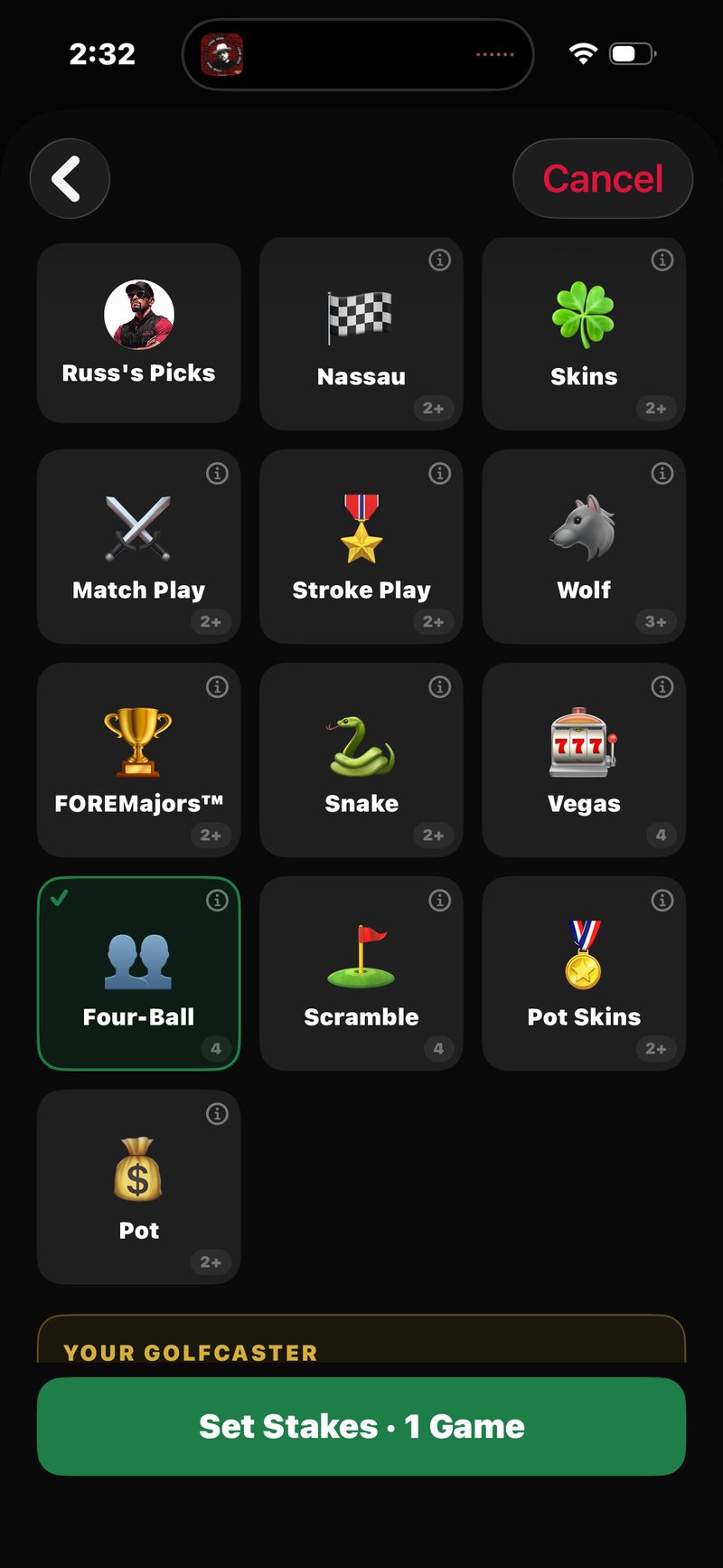
1. Nassau
The classic three-bet structure: Front 9, Back 9, and Overall (all 18). Each segment is its own bet with its own stake, like $5 / $5 / $10. You can win the Front but lose the Back. On a 9-hole round, Nassau is one bet over the nine.
Match or medal
Each segment can be played one of two ways:
- Match play — most holes won wins the segment.
- Medal play — lowest total score over that segment wins.
On the Nassau card, tap Change rules and pick a style:
- MMM. All three segments match play.
- MMD. Front and back match, overall medal.
- DDD. All three medal.
- Custom. Set each segment yourself.
Presses
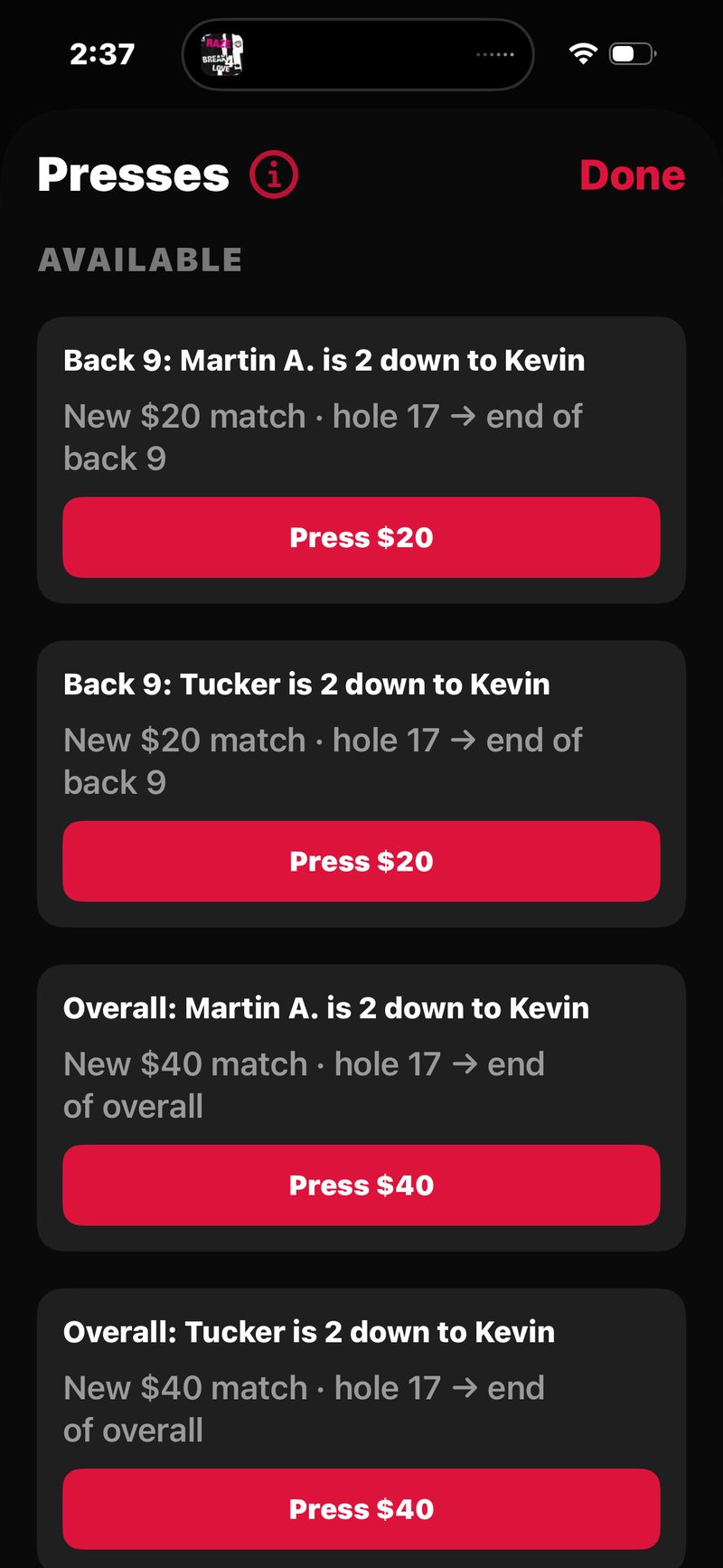
A press is a new bet that runs alongside the original at the same stake, from the next hole to the end of that segment. You can press when you’re 2 or more down: 2 holes in a match segment, 2 strokes in a medal segment. Only the player who’s behind can press (the host presses for a guest). Presses work on Match Play and Stroke Play bets too, not just Nassau.
You can press a press, too. Declare one from ☰ MENU → Presses during the round. The sheet lists every press you can call right now, and one tap on Press $X starts it. Your Golfcaster announces it, and it shows up as a new line on the Standings sheet. Over the closing holes (15–18 on an 18-hole round), the app prompts the player who’s behind when a Nassau match segment can be pressed.
You and Bryan are playing a $5 Nassau (MMM). You win the Front 9 match (+$5). On the Back, Bryan is down 2 holes after hole 14 and presses — that starts a new $5 bet from hole 15 forward. Bryan wins the press on hole 18 (+$5 for Bryan) and wins the regular Back 9 (+$5). The Overall ties.
Net: Front +$5 for you, Back −$5 for you, Press −$5 for you, Overall ties. You owe Bryan $5.
2. Match Play
The simplest version: most holes won across the round wins the match.
Pairwise — every pair plays their own match. If two opponents tie at the end of 18, no money exchanges between that pair.
3. Stroke Play
Pairwise — every pair settles on its own. In each pair, the lower total wins the stake (gross or net, depending on the bet's setting).
4. Skins
One hole = one skin. Lowest score on the hole wins it, once everyone has a score on that hole. Each other player pays the winner the per-hole stake. A player who didn’t finish the hole (DNF) pays too.
The Skins card starts on Classic: par or better to win, carryovers on, birdies pay 2×, handicaps on. Tap Simple for lowest score wins, no carryovers, flat pay, gross scores. Or flip the switches one by one.
Carryover
If two or more players tie for low, the skin carries to the next hole and adds to the pot. Carries can pile up across multiple holes until someone wins outright. This is the Carryovers on ties switch, on by default. Turn it off and a tied hole is just dead.
Par or better to win
- On (the default). You only win if your low score is also par or better. If everyone bogeys, the skin carries even though somebody had the lowest number.
- Off. Lowest score on the hole wins, even a bogey.
Birdies pay 2×
With Birdies pay 2× on (the default), the hole you actually win pays more when you win it with a birdie or better, but only that one hole, never the carry. Carried holes from prior ties always pay their plain per-hole stake.
- Birdie (1 under par) — pays 2×
- Eagle (2 under) — pays 3×
- Double-eagle or better (3+ under) — pays 4× (the cap)
A hole-in-one isn't its own tier — it counts by how far under par it is. An ace on a par 3 is 2-under, an eagle, so it pays 3×. If handicaps are on for the Skins bet the multiplier reads your net score; if not, gross.
$5/skin, Birdies pay 2× on. Holes 1–3 all tie and carry. On hole 4 you win with a birdie (2×). You collect the three carried holes at face value — 3 × $5 = $15 — plus the won hole doubled — $5 × 2 = $10 — for $25 from each opponent.
Win that same hole with a par instead and it's just the whole pot at face value: $20.
5. Wolf
Wolf needs at least three players. The role of "Wolf" rotates one player per hole. With four players, Wolf rotates every hole, repeating after hole 4 — so over 18 holes, each player is Wolf either four or five times.
On your hole as Wolf, you have one decision after each opponent tees off:
- Take a partner. Pick one opponent right after their tee shot. Your team (you + partner) plays the rest of the field for that hole. Lowest team score (best ball) wins.
- Lone Wolf. Skip the partner pick and go solo against the field. The stake doubles for every pairwise edge.
Tradition says if you wait until everyone has teed off and don’t pick a partner, you’re Lone Wolf. In the app, a hole with no Wolf call carries no Wolf money, so make the call. The app reminds you if one is missing.
In the app it’s one tap: the score pad shows a Wolf banner naming the hole’s Wolf, with a button per partner and a LONE 🐺 option — and a wolf howl marks every Lone Wolf call. Need to fix a past hole? ☰ menu → Wolf / Snake.
In a foursome with a $1 Wolf stake, you go Lone Wolf and win the hole. The pairwise stake of $1 doubles to $2 per opponent, so each of the three opponents pays you $2. You collect $6 total.
Lose the same hole as Lone Wolf and you pay $2 to each — $6 out.
Hole ties between sides push — no money moves for that hole.
6. Snake
A side bet on three-putts.
The first player to three-putt picks up "the snake." The next three-putt passes it to them. Whoever's holding it when the round ends pays every other player the stake. Nobody three-putts? Nobody pays.
In the app it’s one tap: a snake button sits beside each name on the score pad — tap to mark the three-putt (cue the rattle). Track your putts in the stats row and your own three-putts feed the snake automatically.
Foursome, $5 Snake. Bryan three-putts hole 7 (he picks up the snake). Ravi three-putts hole 14 (snake passes to Ravi). No more three-putts the rest of the round. Ravi pays each of the other three players $5 — $15 out.
7. Pot
Everyone puts the same bet per player into one pot, and it’s winner-take-all: the lowest net score takes the whole thing (or the lowest gross, if you turn handicaps off). Simple, and great for a group that just wants one number at the end.
Four players put in $20 each, an $80 pot. Martin posts the low net and takes it all: he gets his own $20 back plus $20 from each of the other three, so +$60 for Martin and −$20 for everyone else.
8. Pot Skins
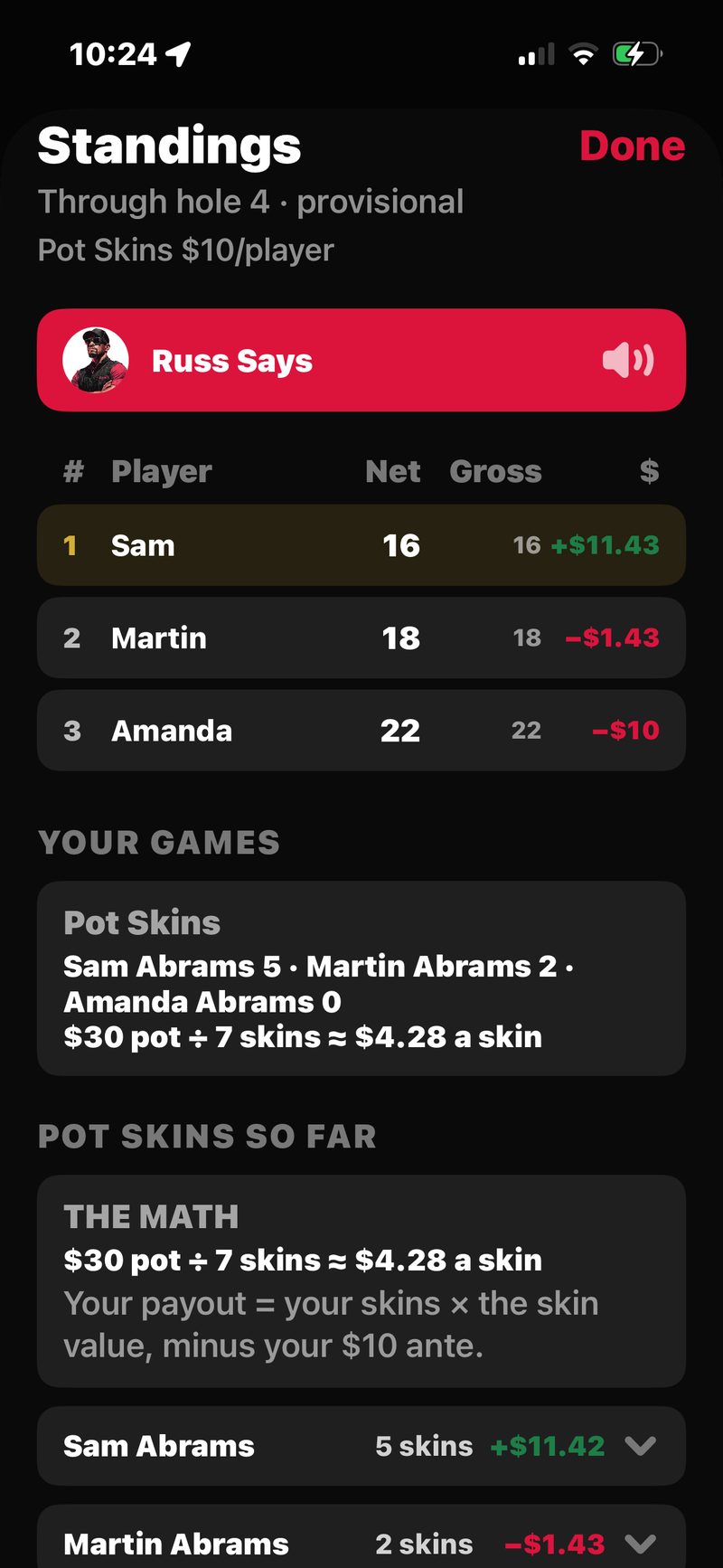
Same one-pot idea as Pot, but instead of one winner-take-all number you earn skins hole by hole and the pot splits by skins won at the end. One player only takes it all if they earn every skin. Only the best score on a hole earns, and it has to be par or better. Net or gross is your call.
Four players bet $10 each, a $40 pot. Ann earns 5 skins, Bo 3, Cy 2, Dee 0. That’s 10 skins total, so each skin is worth $4. Ann’s 5 skins = $20 (+$10 after her own $10), Bo $12 (+$2), Cy $8 (−$2), Dee $0 (−$10).
9. Four-Ball
A 2-on-2 team game. On every hole only the better ball of each team counts — your side’s low score against theirs. Play it match (win more holes than the other team) or medal (lowest best-ball total), net or gross. It’s the classic partners format, and it needs a full foursome. Set the teams on the setup screen: tap a name to switch sides, or hold and drag to swap two players.
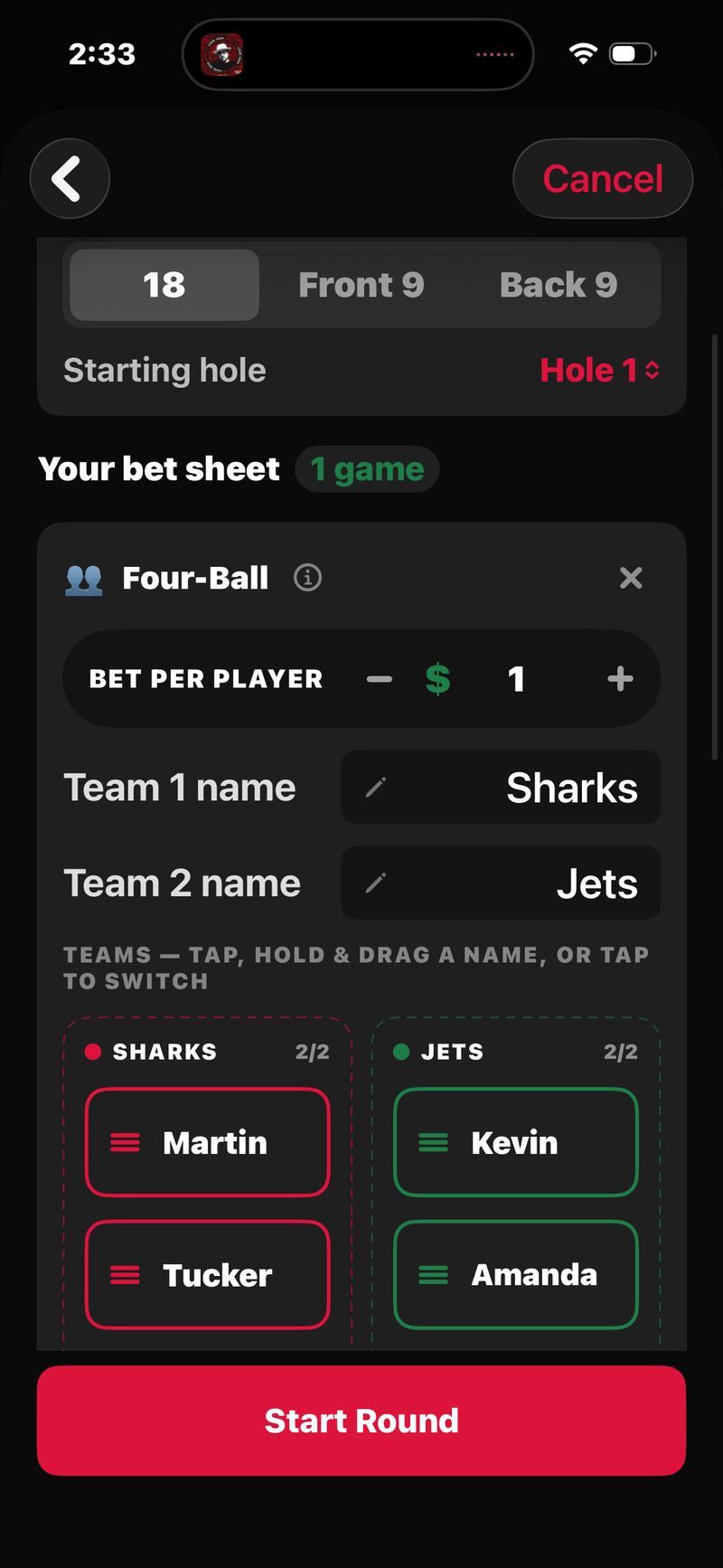
$20 a player. Martin & Sam win more holes than Bryan & Eric, so the match goes to Martin’s team: +$20 for Martin and +$20 for Sam, −$20 each for Bryan and Eric. The winning team pockets $40 between them.
10. Scramble
A 2-man team game, best shot. Both players hit, your team plays the best of the two shots, and you both hit from there — all the way in. The team posts one score each hole. Play it match (hole by hole) or medal (low total). Different from Four-Ball, where you each play your own ball.
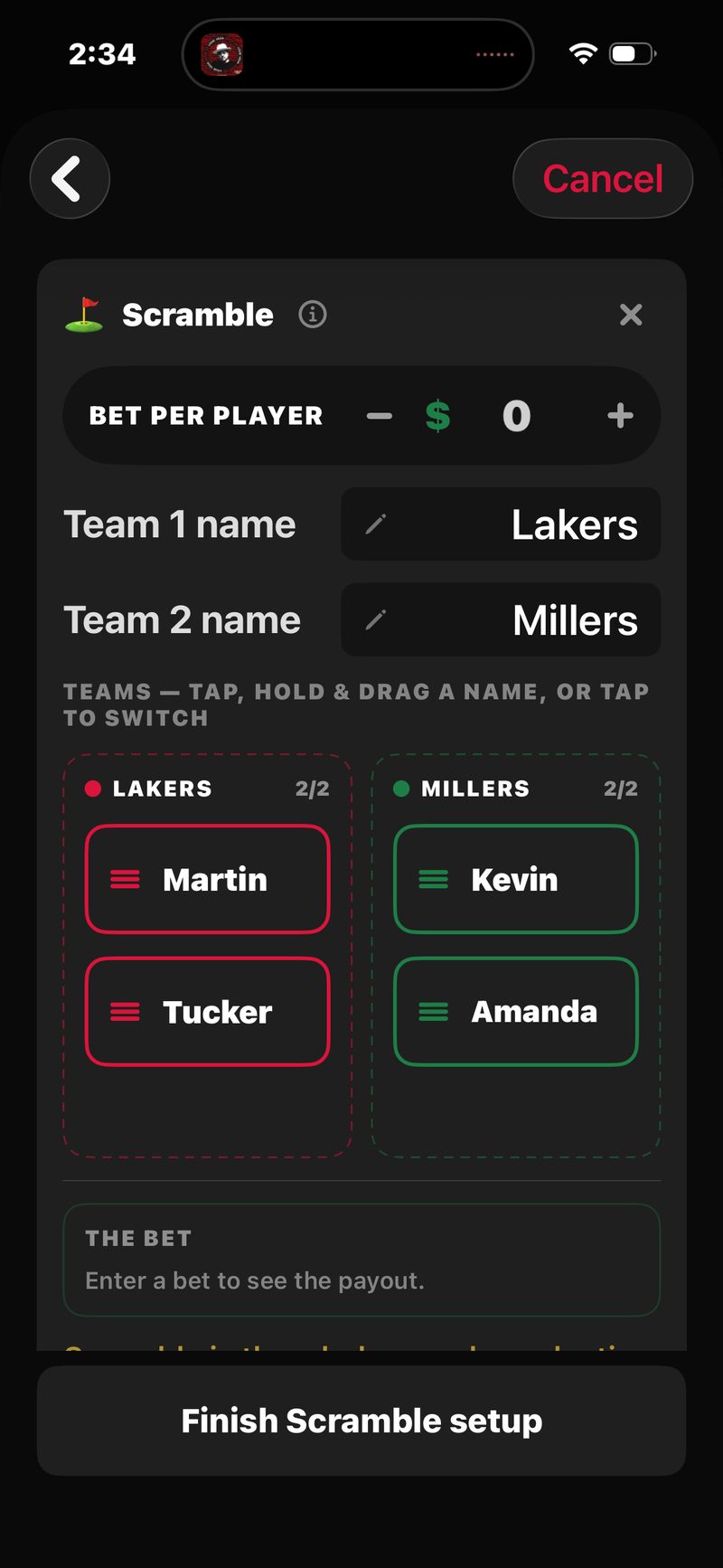
$20 a player, match play. The Nupes beat the Ques over 18, so the match goes to the Nupes: +$20 each for the Nupes, −$20 each for the Ques — the winning team pockets $40. You can name your teams on the setup screen.
11. FOREMajors™
Your 18 splits into six 3-hole stroke-play matches — holes 1–3, 4–6, 7–9, 10–12, 13–15, and 16–18. FOREMajors needs a full 18. Everyone puts the match entry into each of the first five pots; lowest total over the match’s three holes takes that pot, winner-take-all. Win a match and you qualify for the Major — the final 3-hole match, with its own entry, where the champion takes the pot and wears the Crimson Jacket. Your Golfcaster crowns the winner.
$5 a match. Four players, so each of the first five matches carries a $20 pot. You take holes 4–6 outright: +$15 (the $20 pot, minus your own $5) and you’re in the Major for the Jacket entry. Didn’t win a match? You can still buy in for double the Jacket entry. The host records buy-ins from ☰ MENU → Crimson Jacket buy-ins, before the 16th tee.
12. Vegas
A team game for exactly four players: two fixed teams of two for the whole round. On every hole, your team’s two scores pair into one number, low score first: a 4 and a 5 makes 45. Lower team number wins the hole and collects the difference in points: 45 against 56 wins 11 points.
Double digits: if anyone on a team makes a 10 or more, that team’s number goes high score first. That’s the standard Vegas rule. A 4 and a 10 makes 104, not 410. Against a 5 and a 5 (55), that’s 49 points on one hole.
Make a birdie and the other team’s number flips — high score first. Their harmless 4-and-5 becomes 54. One birdie can swing a quiet hole by twenty-plus points. An eagle flips them and doubles the hole’s points. Both teams birdie? The flips cancel. Both teams eagle? The double cancels too.
Handicaps & strokes
Every game except Snake has a Use handicaps (net) switch, on by default. Scramble is always gross. When handicaps are on, the lowest-handicap player in the group plays scratch (zero strokes). Everyone else gets strokes equal to the difference between their handicap and the lowest. The strokes card on Game Setup shows who gets what before you start.
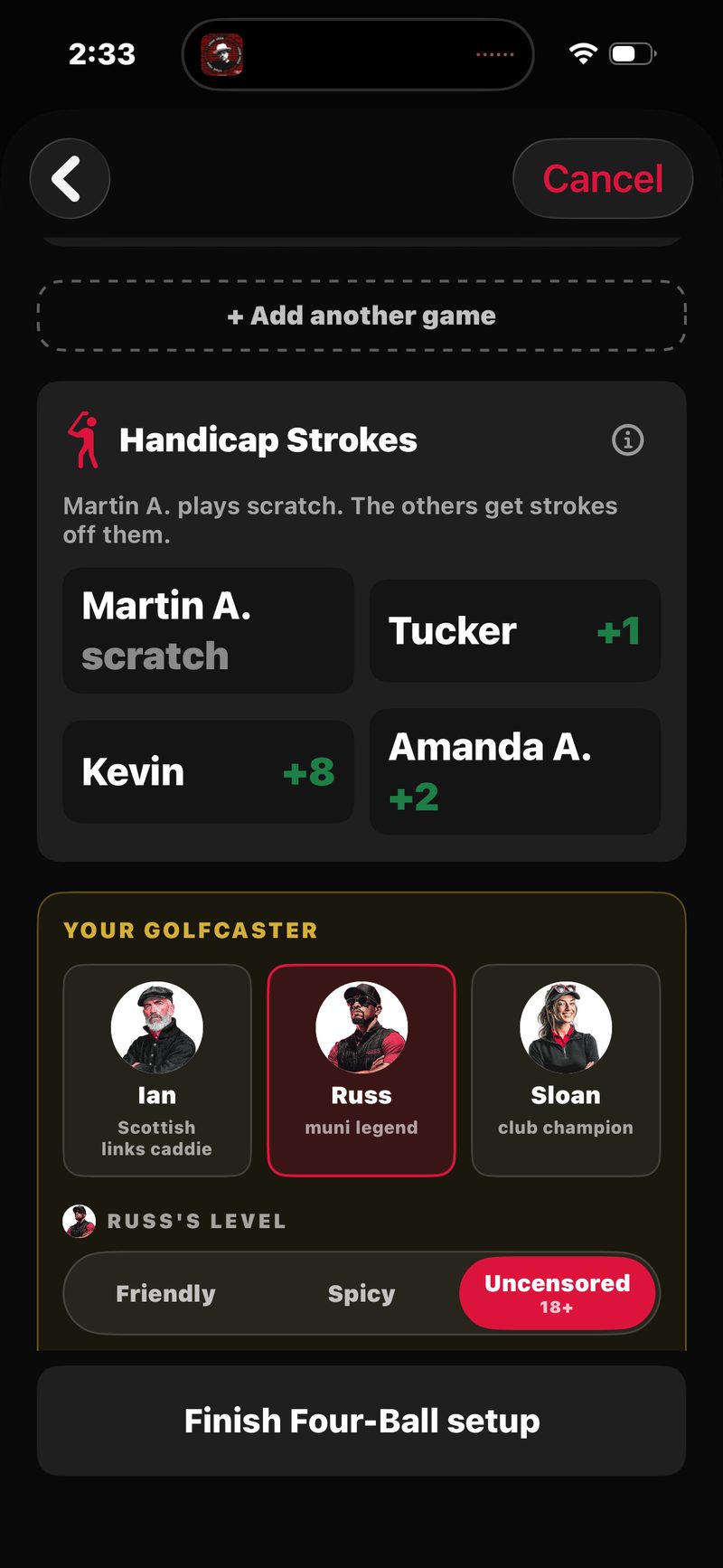
Strokes come from each player’s full Course Handicap, worked out from their own tee’s rating and slope (half of it for a 9-hole round). Handicaps lock when the round starts, and a net game can’t start until every player has one.
Strokes are allocated by Stroke Index: the hardest-rated hole gets the first stroke, next hardest the second, and so on. For very high handicaps, strokes wrap. Every hole gets one stroke before any hole gets a second, and the second strokes start back at the hardest hole.
Strokes appear on the scorecard as small crimson dots in the corner of each player’s score cell. Three or more show as a number, like •3.
Net score = your gross score minus the strokes you receive on that hole. You'll see both numbers in most places — the big number is gross, the small green number underneath is net.
How ties settle
Ties don’t all work the same way — it depends on the game:
- Nassau, Match Play, Stroke Play, Wolf, Four-Ball, Scramble. These settle pairwise (Four-Ball and Scramble, team vs team). When a pair, segment, or match ties, that one pushes and no money moves between those players. Everyone else still settles. A tie never voids the whole round.
- Vegas. If the points come out even, nobody pays.
- Skins. A tie carries the skin to the next hole, adding to the pot (or the hole is dead, if carryovers are off).
- Pot. A tie for low splits the pot evenly between the tied players.
- Pot Skins. Matched scores on a hole earn less (matched pars earn nothing). The pot splits by skins at the end.
- FOREMajors. Sudden death on the next holes you play, then a split if it’s still tied.
Questions on a specific game? Email support@forepaid.app with the round details and we'll walk through it.